More conversions
UX-driven layouts, clear messaging, and friction-free paths to purchase, booking, or contact.

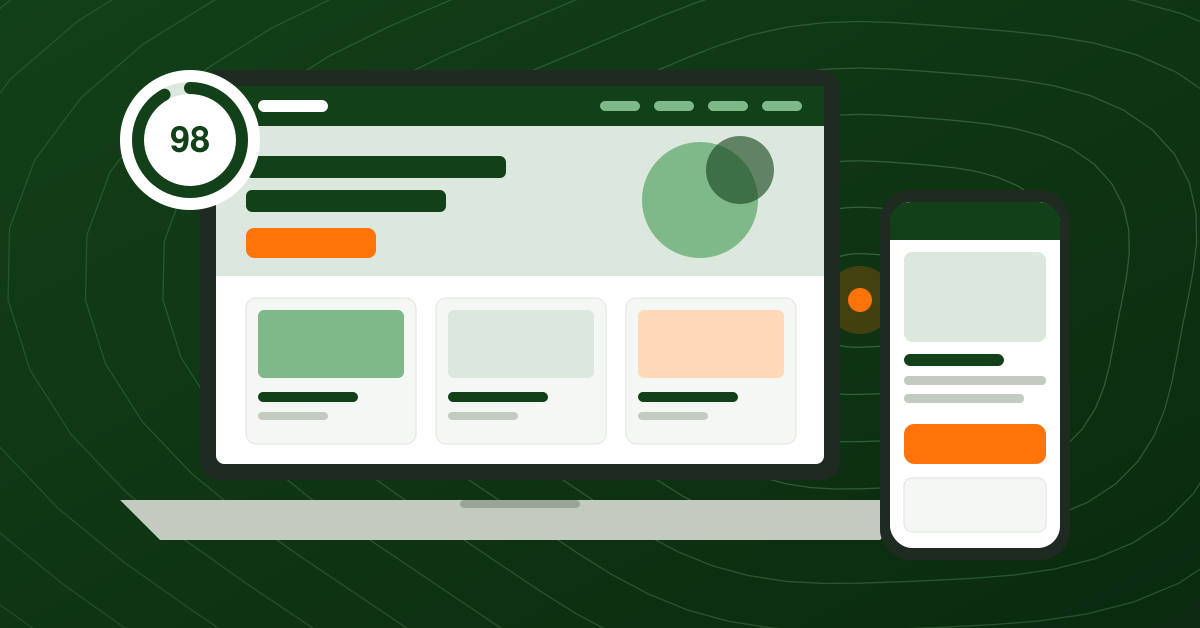
Web Design & Development
Custom websites, Shopify stores, headless builds and web apps, planned with UX research and engineered for speed, search and conversion.
The problem
Your website is often the first and last thing a customer sees before deciding to buy or call. Too many sites are designed for the owner's taste instead of the customer's decision.
Good websites are planned, not just designed.
What changes
UX-driven layouts, clear messaging, and friction-free paths to purchase, booking, or contact.
Fast, technically sound builds with SEO best practices included from day one.
Content management set up so your team can update pages, products, and posts without a developer.
What we do
Customer journey mapping, sitemaps, content architecture, and wireframes before design begins.
Distinctive, on-brand design systems built around your customers and conversion goals, not a recycled template.
Theme customization, custom sections, collection and product page optimization, and app integrations. [CONFIRM Shopify Plus]
Product data structured to flow cleanly from your store to Amazon, Walmart, and other retailers, including integrations with product content platforms like Salsify and Syndigo, plus Amazon Brand Store design. [CONFIRM]
Flexible, easy-to-manage sites for service businesses on the platform that fits your team and budget.
High-performance builds on modern headless CMS platforms like Sanity and Payload, for speed, flexibility, and scale.
Custom web apps, tools, calculators, portals, and interactive experiences that solve real business problems.
Updates, security monitoring, performance tuning, and conversion testing after launch. [CONFIRM]
Who we work with
Shopify stores and custom ecommerce experiences focused on product discovery, trust, and a fast path to checkout, with product data ready to sync to Amazon and Walmart.
Lead-generating websites with clear service pages, online booking or quote requests, reviews, and local SEO structure.
Why Lakefly
Most web projects involve a designer, a developer, and an SEO specialist who never talk to each other, and it shows after launch. [YOUR NAME] brings all three: a CX analyst background, hands-on development across WordPress, Shopify, Wix, Sanity, and Payload, and deep SEO expertise. [CONFIRM]
By the numbers
years building websites
sites launched
What clients say
[Testimonial that mentions the web project experience or results.]
[Second testimonial.]
How we work
Most websites launch in [X–X] weeks, depending on scope and content readiness.
Goals, audience, competitors and how the current site actually performs.
What the build should return, and how big the project should be.
Sitemap, content plan, SEO structure and wireframes for key pages.
Visual design and prototypes, refined through review rounds.
Development, integrations, speed, accessibility and migration planning.
Redirects verified, tracking checked, team trained, then improved.
Discover
Goals, audience, competitors and how the current site actually performs.
Forecast
What the build should return, and how big the project should be.
Architect
Sitemap, content plan, SEO structure and wireframes for key pages.
Design
Visual design and prototypes, refined through review rounds.
Build
Development, integrations, speed, accessibility and migration planning.
Launch
Redirects verified, tracking checked, team trained, then improved.
Engagement models
Best for new builds and redesigns
Service business sites from $[X] / Shopify stores from $[X] / Custom and headless from $[X]
Research, design, development, and launch with SEO and tracking included.
Best for custom tools, portals, and interactive experiences
Custom quote
Scoped after a discovery session.
Best for ongoing updates, optimization, and support
Starting at $[X]
Maintenance, updates, performance monitoring, and conversion improvements.
Plain language
Website quotes are hard to compare because every agency uses these words slightly differently. Here's what they mean to us.
Headless CMS. A content system that stores and manages content separately from the site that displays it, connected through an API. It allows faster, more customizable sites and lets one set of content feed a website, an app, and other channels. The trade-off is that it needs a developer, so it isn't right for every business.
Core Web Vitals. Google's measures of real-world page experience: how fast the main content loads, how quickly the page responds to interaction, and how much the layout shifts while loading. They're a modest ranking factor and a significant conversion factor, and mobile scores are the ones that count.
Information architecture. How pages are structured, named, and navigated: what exists, where it lives, and how someone finds it. It's decided before any visual design, and getting it wrong is the most expensive thing to fix after launch because it changes every URL.
Conversion rate optimization (CRO). Improving the percentage of visitors who take the action you want, rather than buying more visitors. Lifting conversion rate makes every other channel cheaper at once, which is why it's usually the highest-return work available to a site that already has traffic.
Design system. The reusable set of type styles, colors, spacing, and components a site is built from. It's what keeps a site consistent as pages get added, and what lets your team build new pages later without a designer redrawing everything.
Redirect mapping. Matching every URL on an old site to its closest equivalent on the new one, so links and rankings carry over. A redesign that skips this is the single most common way businesses lose organic traffic overnight.
Still have a question? Ask it directly and you'll get a straight answer.
Service business websites start at $[X], Shopify stores at $[X], and custom or headless builds at $[X]. Final pricing depends on page count, functionality, integrations, and content needs.
Most projects launch in [X–X] weeks. The biggest factor in timeline is usually content and feedback turnaround.
Shopify is usually best for ecommerce, WordPress for flexible content-driven sites, Wix for simpler sites that need easy editing, and headless platforms for maximum speed and customization. We recommend based on your goals, team, and budget.
It can if handled poorly. We protect rankings with SEO migration planning, URL mapping, 301 redirects, and post-launch monitoring.
Yes. Every site is set up with an easy-to-use content management system, and we train your team on how to update it.
A headless CMS stores and manages your content separately from the website's front end. That allows faster, more flexible sites and lets the same content power websites, apps, and other channels.
Often yes, and it's usually the cheaper answer. If your site is structurally sound, targeted fixes to speed, structure, and conversion can deliver most of the benefit at a fraction of a rebuild. The audit tells us which path makes sense.
Where we work
Based in Fort Wayne, we design and build websites for businesses across the region and remotely nationwide.
Discovery workshops, planning sessions, and launch training can happen in person across Northeast Indiana. [CONFIRM]
Our home market is Fort Wayne and Northeast Indiana, including New Haven, Huntington, Auburn, Angola, Kendallville, Warsaw, Columbia City, Decatur, and Bluffton. We also serve businesses in Northwest Ohio, Southern Michigan, and south central Indiana. [CONFIRM cities]
Tell us about your business and goals. We'll recommend the right platform, scope and approach, and give you a clear quote. Reply within one business day.
Your Cart
Your cart is empty
Access this document
Pre-Order
Get in touch